
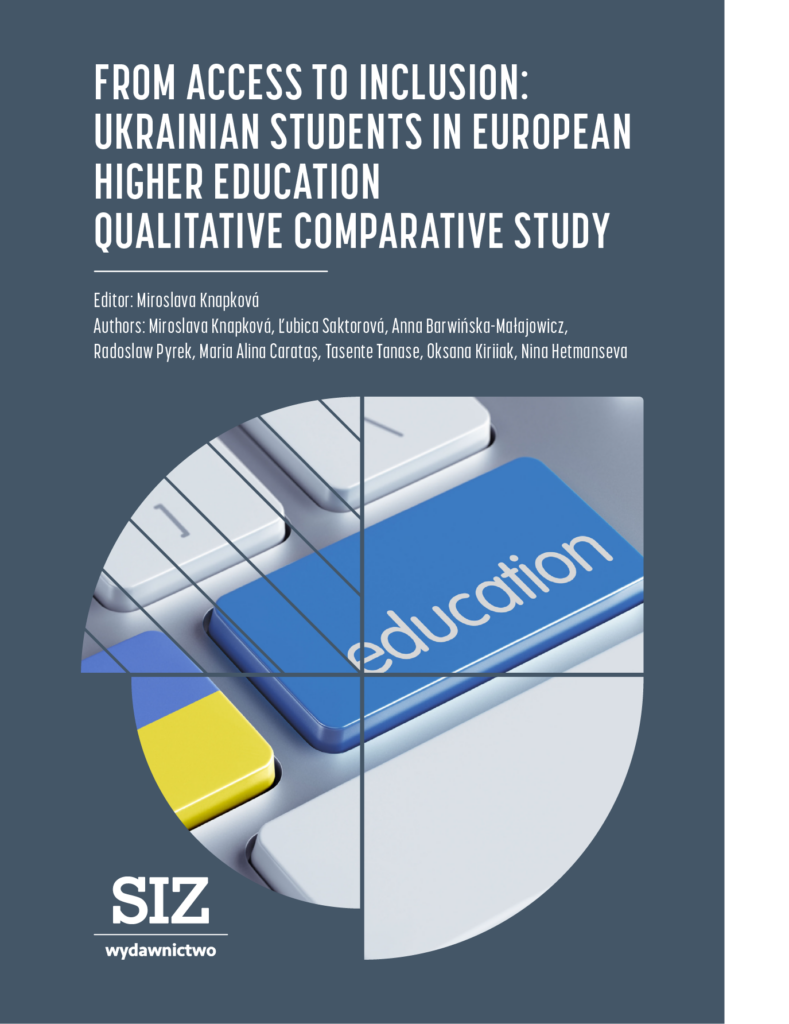
From access to inclusion: Ukrainian students in European higher education. Qualitative comparative study
| E-ISBN | 979-83-68049-56-5 |
| Rok wydania | 2025 |
| Wydawnictwo | Wydawnictwo SIZ |
| Liczba stron | 235 |
| Wolny dostęp | Link |
Contents
Preface
1. Introduction
2. Conceptual and theoretical framework
2.1. Transformations in higher education: European and global contexts
2.2. Harmonization, quality assurance and institutional structures in the EHEA
2.3. Educational migration, student mobility and internationalization
2.4. Legal and policy frameworks for migration, asylum and integration in the EU
3. Methodology
3.1. Research rationale and conceptual anchoring
3.2. Research objectives and research questions
3.3. Qualitative research design: round tables, participant perspectives, and thematic analysis
3.3.1. Research logic and justification of qualitative approach
3.3.2. Participants and composition of round tables
3.3.3. Key thematic areas of the round tables
3.3.4. Data collection, documentation and analysis
3.4. Use of secondary data and institutional sources
3.5. Triangulation, data validation and ethical consideration
4. Results from four countries
4.1. Slovakia
4.1.1. Legal, institutional and policy frameworks for inclusion in Slovakia
4.1.2. Trends in Slovak higher education in connection with Ukrainian students’ inflow
4.1.3. Institutional responses: Matej Bel University case
4.1.3.1. Gender and age of Ukrainian students at UMB
4.1.3.2. Academic programs and study levels of Ukrainian students at UMB
4.1.4. Qualitative analysis – results from round tables at Matej Bel University
4.2. Poland
4.2.1. Legal, Institutional and Policy Frameworks for Inclusion
4.2.2. Trends in Polish higher education in connection with Ukrainian students’ inflow
4.2.3. Institutional responses: the University of Rzeszów case
4.2.3.1. Structure of Ukrainian students at UR
4.2.4. Qualitative analysis – results from round tables at Rzeszów University
4.2.4.1. Good practices and systemic challenges in inclusion
4.3. Romania
4.3.1. Description of the higher education system in Romania
4.3.1.1. Bachelor’s degree studies
4.3.1.2. Master’s degree studies
4.3.1.3. Challenges and perspectives of HE in Romania
4.3.2. Adaptation of Romanian universities for the integration of Ukrainian students
4.3.3. Ovidius University of Constanta – institutional insights and student dynamics
4.3.4. Ukrainian Students in Ovidius University
4.3.5. Qualitative analysis – results from round tables at Ovidius University in Constanta
4.3.5.1. Responses from the perspective of Romanian students
4.3.5.2. Responses from the perspective of Ukrainian students
4.3.5.3. Responses from the perspective of professors
4.4. Ukraine
4.4.1. Description of the higher education system in Ukraine
4.4.1.1. Educational programs and higher education degrees awarded
4.4.1.2. Licensing of educational activities and accreditation of educational programs
4.4.1.3. Organization and structure of the higher education system
4.4.2. Yuriy Fedkovych Chernivtsi National University – Institutional insights and student dynamics
4.4.3. Qualitative analysis – results from round tables at Yuriy Fedkovych Chernivtsi National University .
4.4.3.1. Motivations and benefits of studying abroad
4.4.3.2. Shared educational goals and cultural diversity
4.4.3.3. Integration, language barriers, and cultural adaptation
4.4.3.4. Support programs, study preferences, and academic experiences
4.4.3.5. Challenges, living conditions, and student advice
5. Comparative synthesis, SWOT analyses and recommendations
5.1. SWOT analyses by country
5.1.1. Slovakia
5.1.2. Poland
5.1.3. Romania
5.1.4. Ukraine
5.2. Cross-country comparative insights
5.3. Policy and institutional recommendations
6. Conclusions and future directions of research
References
Authors
List of Figures
List of Tables